
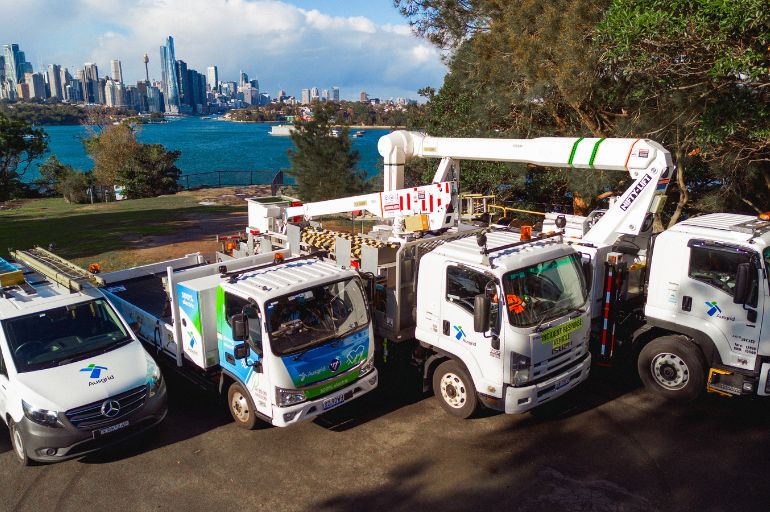
Keeping the power on: How Ausgrid is modernising one of Australia’s most complex utility fleets
Ausgrid’s purpose is to make electricity accessible for all, and their fleet supports the safe and reliable supply of electricity to more than four million customers across Sydney, the Central Coast, Newcastle, the Hunter and Upper Hunter.
With approximately 1,600 vehicles and another 700 items of plant and equipment, the fleet must be ready for everyday network maintenance, remote access, major construction and emergency response. Through strong governance, detailed asset information, targeted safety initiatives and fleet electrification at scale, Ausgrid is building an operation designed for both reliability and change.
Why vote for Ausgrid?
- Ausgrid manages one of Australia’s most complex utility fleets, supporting electricity services relied upon by more than four million people.
- Its fleet team has established a clear strategy built around safety, operational suitability, value and electrification. Detailed asset records, digital maintenance systems and driver-behaviour reporting provide the governance required to manage specialist equipment across a large geographic area.
- At the same time, Ausgrid is moving beyond passenger vehicle electrification by introducing electric vans, trucks, mobile maintenance and a charging network designed around real operating requirements.
- Vote for Ausgrid in the 2026 Fleet News Group Fleet of the Year Award and recognise a fleet that is combining operational resilience with practical innovation, strong accountability and an ambitious transition to a lower-emission future.
Fleet snapshot
- Approximately 1,600 vehicles
- Around 700 items of plant and equipment
- More than four million customers
- Approximately 1.8 million electricity connections
- Around 130 elevated work platforms
- Approximately 30 pole borers
- 14 prime movers supporting an in-house freight operation
- Specialist cable-handling equipment, boats and off-road assets
- 11 per cent of the fleet electrified at the time of the interview
- Target of approximately 900 vehicles electrified by the end of FY2029
- Currently 11% of Ausgrid’s fleet is electric
A fleet that must respond when the power goes out
Ausgrid’s fleet is unlike a conventional passenger or commercial vehicle operation.
Its vehicles and equipment allow crews to install poles, maintain overhead wires, transport heavy materials, recover and tension cables, inspect remote assets and restore electricity following storms and other network incidents.
The operation includes elevated work platforms, pole borers, prime movers, cable-management equipment, specialist off-road vehicles and boats.
Some customers along the Hawkesbury River can only be reached by water. Ausgrid operates vessels capable of carrying crews and equipment to these locations when maintenance or emergency repairs are required.
Other assets include side-by-side vehicles used to inspect powerlines and access difficult terrain after storms. Ausgrid also operates its own drone capability for pole and network inspections.
This diversity creates a difficult fleet-management challenge. Assets must be safe, compliant and productive during normal operations, but Ausgrid must also retain enough capacity to respond when severe weather causes widespread outages.
Reducing the fleet too aggressively could limit emergency capability. Maintaining too many underused assets would increase costs ultimately borne by electricity customers.
The fleet team must continually balance utilisation, availability, operational risk and whole-of-life value.
Four pillars guiding the fleet
Ausgrid’s CEO-endorsed fleet strategy covers FY2026 to FY2029 and is structured around four pillars:
- Safe to work
- Fit for purpose
- Value for money
- Electrification
These priorities connect fleet decisions with the organisation’s wider operational and financial responsibilities.
Safe to work covers driver behaviour, training, equipment safety and the systems required to protect employees and the public.
Fit for purpose ensures vehicles and equipment match the work being completed. It also includes fleet allocation, utilisation and maintaining sufficient capacity for major storm events.
Value for money focuses on cost optimisation and workforce productivity. As Ausgrid operates within a regulated electricity network, unnecessary fleet expenditure may ultimately contribute to higher costs for consumers.
Electrification provides a roadmap for reducing emissions while demonstrating that a large and complex operational fleet can transition to electric vehicles without compromising safety or reliability.
Each pillar is supported by performance measures, providing a clear connection between strategy and operational delivery.
Following every asset through its working life
SAP is Ausgrid’s principal source of fleet and asset information.
The system provides visibility across an asset’s life, from initial planning and procurement through to servicing, incidents, operating costs and disposal.
Purchasing and contract records are held digitally, together with pre-purchase risk assessments, commissioning information and training documentation.
Maintenance information for internally managed heavy vehicles and plant is captured through the BlueWorx digital platform and transferred into SAP. Information relating to light vehicles is also received digitally through Ausgrid’s fleet management arrangements.
This creates a lifecycle record covering fuel, servicing, tyres, incidents, expenditure and asset history.
Ausgrid’s fleet team can produce a current asset register and receives regular reporting showing information such as asset age and fleet composition. In-vehicle monitoring systems and Power BI dashboards provide additional operational visibility.
Automated controls can also identify unusual activity. For example, a fuel transaction that exceeds a vehicle’s tank capacity can be flagged for investigation.
This combination of systems allows Ausgrid to move beyond isolated spreadsheets and maintain a more complete view of each asset.
Maintenance that can change with the fleet
Ausgrid manages a wide variety of equipment, from passenger vehicles and trailers to elevated work platforms worth more than $1 million.
Maintenance requirements are governed by several frameworks, including the National Heavy Vehicle Accreditation Scheme, the Heavy Vehicle National Law and relevant Australian Standards.
Digital maintenance documentation allows Ausgrid to respond quickly when new information becomes available.
When an issue is identified internally or reported by another electricity network operator, service documentation can be updated immediately. The next technician opening the digital service sheet receives the revised version.
This is particularly important for specialist equipment where a failure may create a safety risk or prevent crews from completing essential work.
Digital records, controlled documents and defined review processes also reduce the risk of outdated instructions remaining in use.
The organisation maintains documented procedures covering vehicle servicing, safe equipment operation, pre-start inspections and other fleet activities. Controlled documents are reviewed according to their importance and must pass through the appropriate management and executive approval process.
Turning driver data into safer behaviour
Safety is central to Ausgrid’s fleet strategy.
In-vehicle monitoring systems record factors such as speeding, harsh braking and other driving behaviours. This information is used to create driver scores and identify employees who may benefit from additional support.
Drivers can view their own performance through dashboards, while reports are also provided to supervisors.
Employees recording the highest-risk results may receive a letter signed by the CEO encouraging them to review their behaviour and improve their performance.
Ausgrid is moving towards a more targeted, risk-based training model. Rather than providing the same program to every employee, the fleet team is assessing options such as defensive-driving education and practical driver re-evaluation for those presenting the greatest risk.
The organisation is also developing a depot-based initiative that uses driver scores based on speeding and harsh breaking that they call the “Good Driving Score” to encourage teams to improve collectively.
This approach reflects a shift from simply recording incidents to using leading indicators and behavioural data to reduce risk before an incident occurs.
Electrifying a complex operational fleet
Ausgrid is working to demonstrate that fleet electrification can be achieved at scale.
At the time of the interview, approximately 11 per cent of the fleet had been electrified. The organisation was targeting 24 per cent by the end of FY2027 and approximately 60 per cent by the end of FY2029.
Most of the passenger fleet has already transitioned to electric vehicles. Ausgrid has also introduced close to 30 electric vans and five electric trucks in the 4.5-tonne class, while testing larger electric vehicles for freight and operational work.
The transition is not limited to vehicle procurement. Charging infrastructure is being developed through a hierarchy covering depots, substations, employees’ homes and public charging.
Most charging will take place at depots. Substation charging will provide additional operational support, although Ausgrid wants to minimise unnecessary time spent at these locations because of the risks associated with electricity infrastructure.
The organisation has been testing 40kW portable DC charging at substations, including the potential for vehicle-to-vehicle charging if an electric vehicle is unable to reach a fixed charger.
Home charging is also being considered for employees with take-home vehicles. Ausgrid is working towards a system that could use vehicle data to calculate home electricity use and reimburse employees automatically through payroll.
These initiatives recognise that successful electrification depends on the complete operating system around the vehicle, not only the vehicle itself.
Taking maintenance to the vehicle
Ausgrid has also introduced a mobile mechanic service to reduce the cost and disruption associated with transporting trucks to workshops.
The service uses an electric truck and allows maintenance support to travel to operational assets.
For a utility fleet, this can reduce towing expenses, limit vehicle downtime and keep employees productive by avoiding unnecessary travel to and from maintenance facilities.
It is another example of the fleet team combining electrification with a practical operational improvement.
Results that matter
Ausgrid’s fleet program is delivering a stronger foundation for long-term performance:
- A CEO-endorsed strategy connects fleet activity with organisational priorities
- SAP provides whole-of-life asset visibility
- Digital maintenance systems allow safety information to be updated quickly
- Telematics and Power BI dashboards support driver and fleet monitoring
- Risk-based driver initiatives target employees requiring the most support
- Most passenger vehicles have been electrified
- Electric vans and trucks are moving electrification into operational roles
- Depot, substation and home-charging solutions are being developed
- Mobile maintenance is reducing the need to transport vehicles to workshops
- Fleet planning balances everyday utilisation with emergency-response capacity
Preparing for the next storm
Ausgrid cannot manage its fleet solely around average daily utilisation.
When storms damage the electricity network, the organisation needs enough vehicles, equipment and trained employees to restore power quickly. Fleet availability can directly affect restoration times, community disruption and the financial penalties associated with network service performance.
This means Ausgrid must electrify and optimise its fleet while protecting resilience.
Vehicle range, charging access, specialist equipment requirements and emergency operating conditions must all be considered before an asset is replaced.
Ausgrid’s approach is therefore based on staged deployment, testing and operational learning. Passenger vehicles have provided the first large-scale opportunity, followed by vans, small trucks and trials involving heavier equipment.
The objective is not electrification at any cost. It is to build an electric fleet capable of supporting the same essential services as the vehicles it replaces.
Leading through governance and practical innovation
Ausgrid believes strong fleet management begins with safe, compliant and well-governed operations.
From that foundation, the organisation is using technology, behavioural data and infrastructure planning to accelerate change.
The scale and diversity of the fleet make that transition particularly significant. Ausgrid is not only replacing passenger vehicles used for routine travel. It is examining how electrification can support freight, field service, maintenance and specialist network operations.
Its experience can provide a useful example for other large fleets considering how to reduce emissions without weakening operational capability.