
How Blacktown City Council transformed one of Australia’s largest council fleets
Blacktown City Council manages a large and diverse fleet supporting essential services across one of Australia’s fastest-growing communities. Through stronger data, proactive maintenance, specialist expertise and a practical transition to lower-emission vehicles, its City Fleet team is demonstrating what a modern local government fleet can achieve.
Why vote for Blacktown City Council?
Blacktown City Council has transformed a large and operationally demanding fleet through practical innovation, disciplined maintenance and better use of data.
Its City Fleet team is reducing downtime, improving asset utilisation, building specialist capability and accelerating the transition to lower-emission vehicles without losing sight of essential community services.
Rather than relying on fleet growth to meet increasing demand, Blacktown is finding ways to use assets more efficiently and make decisions based on duty cycle, performance and whole-of-life value.
Fleet snapshot
- Approximately 2,000 registered assets
- Around 600 heavy vehicles
- About 70 waste collection and street-cleaning vehicles
- Approximately 400 passenger and light commercial vehicles
- 55 permanent fleet employees
- 10 casual employees and contractors
- 53 per cent of the fleet hybrid, plug-in hybrid or fully electric at the time of the interview
- Target of zero tailpipe emissions by 2038
When reliability means thousands of bins
For Blacktown City Council, fleet management is not simply about purchasing vehicles and arranging servicing. It directly affects the council’s ability to deliver essential services to the community.
A waste collection truck can complete approximately 1,200 bin lifts each day. If three trucks are unavailable, thousands of bins may be left uncollected and the council must quickly find alternative vehicles and crews.
Some of Blacktown’s street-cleaning assets operate for up to 16 or 17 hours a day across multiple shifts. These vehicles work in public spaces, often under demanding operating conditions, and there is little room for unexpected downtime.
This operational pressure has driven the City Fleet team to move away from reactive maintenance and traditional replacement practices. The objective is to identify problems earlier, make better use of existing assets and ensure vehicles remain available when frontline teams need them.
Replacing age-based decisions with better data
Blacktown City Council operates under a rolling 10-year asset management plan, supported by an additional roadmap covering the transition to zero-emission vehicles.
Importantly, replacement decisions are no longer based primarily on the age of an asset. Utilisation, duty cycle, operating requirements, maintenance history and whole-of-life costs are considered before a vehicle is replaced or reassigned.
Telematics and customised dashboards provide visibility of utilisation, downtime, speeding and other operational information. Different council departments receive reporting tailored to their needs.
The waste team, for example, may require daily visibility of downtime and vehicle activity. Parks and green-space managers may need monthly reports concentrating on utilisation and driver behaviour.
This allows the fleet team to identify underused vehicles, rotate assets between departments and avoid purchasing additional equipment unnecessarily.
Standardising bodies and accessories also makes vehicles easier to move between teams. Rather than creating a different specification for every user, Blacktown has developed consistent requirements for different asset classes while retaining flexibility where specialist equipment is required.
One source of information
Blacktown maintains a single asset register covering assets from acquisition through to disposal.
Structured dropdown menus and automatic classifications help reduce data-entry errors. Assets are allocated the appropriate category depending on factors such as vehicle type and weight, while standard descriptions prevent inconsistent manufacturer and model information.
Vehicle identification numbers are also recorded, allowing parts to be ordered for the correct vehicle. The system can create parts requirements ahead of scheduled servicing, supporting better preparation and reducing avoidable delays.
Fleet procedures are documented through the council’s internal process-mapping system. Employees can search for an activity and follow the required steps covering areas such as vehicle specification, procurement, consultation, delivery, maintenance and disposal.
This means knowledge is embedded in the organisation rather than relying solely on the experience of individual employees.
From reactive repairs to proactive maintenance
A key part of Blacktown’s transformation has been its maintenance strategy.
The council uses a combination of internal and external resources to manage servicing and inspections. This hybrid model reflects the difficulty of recruiting experienced heavy diesel technicians while retaining important capability within the organisation.
Vehicles operate on a 13-week maintenance cycle. Three inspections or services may be completed internally, with another completed externally each year. This provides an additional independent check and reduces the risk of problems being missed.
Heavy vehicles also undergo regular mechanical inspections in addition to the driver’s normal pre-start check. Internal and external technicians inspect different vehicles, creating an added layer of accountability.
The result has been a significant reduction in reported defects. According to the fleet team, daily defect lists that previously ran to approximately 17 pages have fallen to around six or seven individual items.
For vehicles completing intensive waste and street-cleaning duties, detecting problems before a breakdown occurs improves safety, reliability and service continuity.
Bringing drivers through the transition
Blacktown’s move towards lower-emission vehicles has happened quickly.
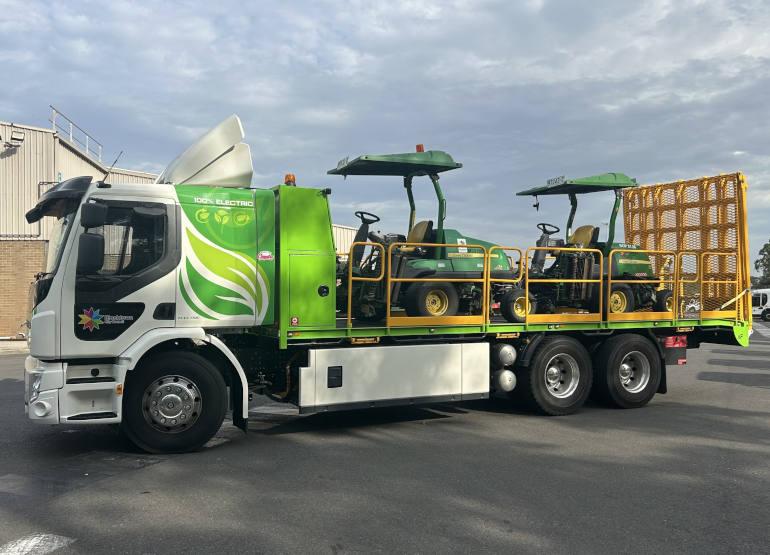
Two years before the interview, approximately five per cent of the fleet was described as ready for electrification. At the time of the interview, 43 per cent of the fleet consisted of hybrid, plug-in hybrid or fully electric vehicles.
The fleet team did not approach this transition by simply purchasing new technology and handing over the keys. Drivers and operational teams were involved in vehicle trials, testing, specification, delivery and familiarisation.
This helped employees understand how the vehicles would perform in their normal working environment and allowed the fleet team to address concerns before broader deployment.
The transition is also producing financial benefits. The council provided an example in which a diesel light vehicle could consume approximately $20,000 worth of fuel over a comparable period, while an electric alternative used around $4,000 to $5,000 worth of electricity.
Electric vehicles have also reduced routine maintenance requirements, with servicing increasingly based on vehicle condition and onboard notifications rather than traditional annual schedules.
The team says that once drivers become comfortable with electric vehicles, many are reluctant to return to conventional vehicles.
Building the right team
Technology alone has not delivered Blacktown’s fleet transformation.
The council created specialist positions covering technical projects, innovation, zero-emission vehicles, alternative fuels, analytics and communications.
Before a replacement vehicle is selected, the team considers telematics data, utilisation, duty cycle and operational requirements. It then assesses whether the best solution is electric, hybrid or a conventional diesel vehicle.
The process also includes vehicle design, discussions with users, procurement documentation and planning for operational differences.
This structure allows Blacktown to combine technical knowledge with practical feedback from the people using the vehicles every day.
Results that matter
Blacktown City Council’s approach has delivered several practical outcomes:
- Daily defect reporting has reduced significantly
- Preventative inspections are identifying faults before breakdowns occur
- Fleet data is improving utilisation and replacement decisions
- Electric vehicles are reducing energy and maintenance costs
- Standardised vehicles can be reassigned between operational teams
- Tailored dashboards provide managers with relevant operational information
- Employees are being supported through the transition to new technology
Preparing for future growth
Blacktown’s population and urban density are expected to continue growing. Areas previously occupied by detached homes are being opened to larger residential developments, increasing pressure on waste collection, street cleaning and other council services.
The fleet team does not believe the answer is simply to purchase more vehicles.
Blacktown is preparing to introduce electric rear-loading waste trucks and investigate whether quieter vehicles can operate across longer hours. Running a vehicle over an additional shift could increase service capacity without adding another asset to the fleet.
This approach would reduce parking pressure, improve utilisation and help the council respond to growth without repeatedly expanding the size of its fleet.
The long-term objective is to achieve zero tailpipe emissions by 2038 while continuing to provide reliable services to the community.
Challenging assumptions about government fleets
Blacktown City Council wants its work to demonstrate that government fleets can move quickly, adopt new technology and compete with well-resourced private organisations.
City Fleet Manager Kris Nair summed up the team’s approach:
“It’s not about what we can’t do; it’s about what we can do within our controls.”
Blacktown is also prepared to share its experiences, including the projects that have succeeded and the lessons learned when an initiative did not go to plan. The team believes its journey can help other councils begin their own fleet improvement programs.
Vote for Blacktown City Council in the 2026 Fleet News Group Fleet of the Year Award and recognise a local government fleet that is challenging assumptions, sharing its knowledge and preparing its organisation for the future.