
How Townsville City Council turned fleet data into safer driving
Townsville City Council has transformed telematics from a source of concern into a practical safety tool that is changing driver behaviour, informing management decisions and helping reduce incidents across a complex local government fleet.
The safety challenge
Townsville City Council manages approximately 1,000 registered and GPS-tracked assets, with the broader fleet extending to about 3,000 items when minor plant and equipment are included.
The diverse operation covers passenger and light commercial vehicles, trucks, refuse collection vehicles, graders, excavators, dozers, tractors, mowers, boats and specialist equipment. These assets support around 1,800 council employees across an area extending approximately 150 kilometres from north to south.
Managing safety across such a varied fleet requires more than responding to crashes. Council must address speeding, harsh driving, pedestrian risks, maintenance compliance, heavy-vehicle obligations, near misses and the everyday hazards created when vehicles and people work in close proximity.
One of the council’s biggest challenges was gaining acceptance for the use of GPS and driver-behaviour information. Developing the administrative framework required consultation and took around 12 months, with employees concerned that the technology could become a disciplinary surveillance tool.
Townsville City Council needed to demonstrate that the data could be used constructively.
Why vote for Townsville City Council?
Townsville City Council has shown that introducing telematics is only the beginning. Its achievement has been turning potentially contentious driver data into a widely accepted safety program that encourages accountability, conversation and improvement.
The council has combined technology with incident investigation, practical vehicle modifications, executive reporting and employee engagement. Most importantly, it has produced measurable reductions in speeding events, vehicle incidents and repair costs.
What changed
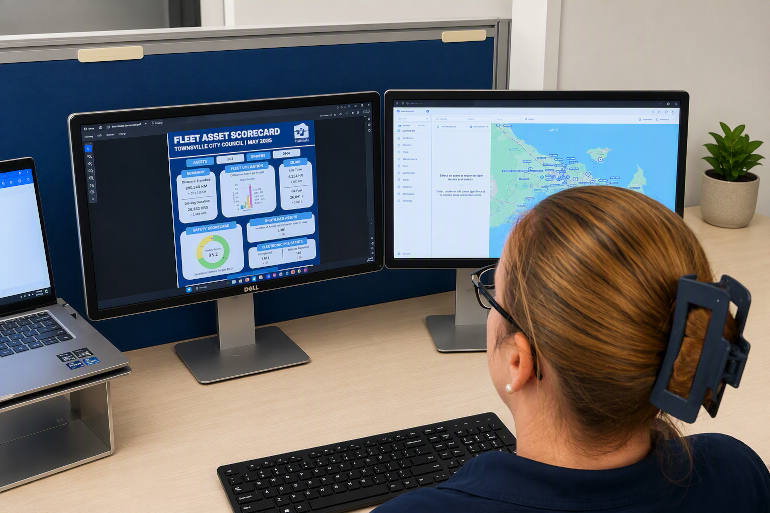
The council began using its Geotab data to create a monthly fleet asset scorecard covering speeding, harsh braking, harsh cornering, harsh acceleration, extended trips, idling and other indicators.
Initially, the reports focused on vehicles rather than naming individual drivers. This allowed Fleet Services to introduce the information as a safety improvement tool while giving business unit managers the ability to investigate recurring risks and have appropriate conversations with employees.
The reports now provide managers with regular visibility of what is happening within their fleets, rather than waiting for an infringement, insurance claim or collision.
Real-time audible alerts also give drivers an opportunity to correct their behaviour immediately. Instead of receiving a report weeks after a speeding event, the driver receives feedback while the event is occurring.
“The beauty that’s helped with this is when they have had those types of infringements, they’ve got a real-time alarm,” Fleet Services team manager Tony Beck explained during the interview.
From data to action
The monthly scorecard is distributed to business unit managers, who can request more detailed information where required. Fleet-related safety statistics are also included in the organisation’s monthly safety reporting to management and the executive team.
Managers have used the data to progressively address the most serious behaviours. Speeding more than 20km/h above the limit was treated as an immediate priority, with the practical target of reducing genuine on-road events to zero. Once the highest-risk events were controlled, attention shifted to lower speeding categories.
The council has deliberately focused on education and behavioural change rather than relying solely on enforcement. Some teams have created friendly competitions around their monthly safety scores, with barbecues used to recognise the best-performing business units.
This approach has helped change perceptions of telematics. Employees who were initially sceptical now discuss their individual results and compare performance with colleagues.
Fleet data is supported by a comprehensive incident management system covering crashes, near misses and improvement opportunities. Corrective actions can then be incorporated into vehicle specifications, training or operational procedures.
Addressing frontline risks
Technology is also being used to manage risks specific to council operations.
Much of the refuse collection fleet was already fitted with AI-enabled pedestrian detection around the bin-lifting arm. Following an incident investigation, the council identified an additional blind spot near the front corner of the vehicle when operators changed driving positions.
Fleet Services worked with suppliers to extend the existing detection system into this area. Seven new trucks received the technology during production, while another five vehicles were retrofitted. Twelve refuse trucks now have both bin-lift-zone and blind-spot pedestrian detection.
Other corrective actions have included park-brake alarms, reversing technology and a “360-degree walk-around” campaign encouraging drivers to take 60 seconds to inspect the area surrounding a vehicle before moving.
The results
Townsville City Council’s safety outcomes
- 48% reduction in recorded speeding events between March 2025 and May 2026
- Around 12,500 fewer speeding events each month
- 242 to 189 reduction in reported vehicle incidents between FY2024/25 and FY2025/26
- $326,025 to $203,000 reduction in associated repair costs
- 12 refuse trucks equipped with expanded AI pedestrian detection
Council does not claim that telematics alone caused the reduction in incidents and repair costs. However, it considers improved visibility, regular reporting and management intervention to be important contributing factors.
The people behind the program
Townsville City Council’s Fleet Services operation includes approximately 45 employees across workshop, acquisition, administration and support functions.
The council is also investing in future capability, with around 12 apprentices in the workshop program, including automotive electrical expertise needed to support increasingly sophisticated vehicles and safety systems.
Heavy-vehicle compliance is integrated into the acquisition and asset-management process. A dedicated National Heavy Vehicle Regulator resource sits within Fleet Services, while organisation-wide chain-of-responsibility training helps employees and executives understand their obligations.
The council has also developed a close working relationship with the regulator’s local office, allowing it to seek guidance and improve its interpretation of complex regulatory requirements.
What comes next
The council acknowledges that there is still work to do.
Improving the completion and timeliness of vehicle pre-start inspections remains a priority, particularly where responsibility sits with supervisors outside Fleet Services. Preventative maintenance reporting for light vehicles also needs to reach the same standard applied to regulated heavy vehicles.
Fleet Services also intends to build on the acceptance of its safety scorecards by encouraging greater focus on utilisation, fuel consumption and operational efficiency.
The next phase is not simply about collecting more data. It is about turning established trust in the reporting system into broader improvements across the fleet.