
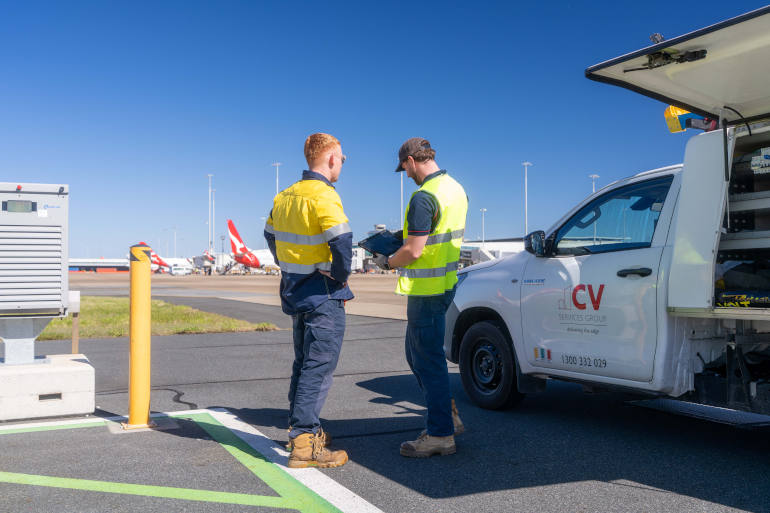
How CV Services made fleet risk measurable and actionable
CV Services operates a fast-growing fleet in high-risk working environments. Its response has been to create a sophisticated safety management framework that turns millions of telematics records into clear actions, accountable owners and measurable behavioural change.
The safety challenge
CV Services is a multidisciplinary construction, infrastructure, asset management, power and renewables business based in Brisbane.
The organisation employs approximately 900 people and operates nationally, with a particular focus on south-east Queensland. Its workforce includes tradespeople, apprentices, engineers, project managers and employees in professional and support roles working across construction sites, facilities, infrastructure and signage projects.
The fleet contains around 500 assets, including light vehicles, trucks, trailers and plant. It is growing by approximately 50 assets annually and was expected to reach around 550 assets within six months of the finalist interview.
Its 813 active drivers collectively travel about 8.5 million kilometres each year.
That scale creates a substantial exposure to speeding, distraction, seatbelt non-compliance, fatigue, collisions and inconsistent vehicle inspections. Because different business units operate in different environments and drive different distances, simply counting incidents would not provide a fair or useful comparison.
CV Services needed a system that could identify risk accurately and tell managers exactly what to do about it.
Why vote for CV Services?
CV Services has created a mature safety framework that goes far beyond installing telematics.
It measures risk according to fleet exposure, converts data into business-unit targets, identifies high-risk drivers by name and assigns every corrective action to an accountable owner. Its technology, training and consequence framework are producing substantial reductions in speeding and at-fault incidents.
What changed
Fleet safety is integrated into the organisation’s broader risk and assurance structure.
Safety ultimately reports to the chief risk officer, while the fleet team manages vehicles, telematics, servicing and maintenance. The risk team analyses the data, identifies behavioural trends and develops actions in partnership with fleet management.
Each year, the executive team receives a detailed driver behaviour report covering:
- Speeding frequency and severity
- Performance by business unit
- Seatbelt compliance
- Fatigue events
- Driver risk classifications
- Data quality
- Priorities and targets for the year ahead
CV Services measures events against distance travelled, rather than relying only on raw totals. This frequency-based approach allows the business to compare a division operating 200 vehicles with one operating 30 vehicles on a more meaningful basis.
The organisation then produces more detailed reports for individual business units, turning the group-level findings into local actions.
From data to action
CV Services has developed a formal safe driving matrix to create consistency in the way managers respond to safety events.
Drivers begin with 1,000 points. Points can be deducted for behaviours and compliance failures including serious speeding, incomplete vehicle inspections, mobile-phone infringements and at-fault incidents.
The severity and frequency of an event determine the response. Escalation can include a discussion with the driver’s manager, retraining, a formal warning, engagement with the people and culture team or a meeting with the relevant general manager.
The matrix was created because managers previously lacked a consistent framework for difficult safety conversations.
“We found that our managers didn’t know how to have the conversation,” fleet manager Kyle Morley said. “This was extremely effective in making it clear what the escalation was.”
New risks can be incorporated as they emerge. Following analysis of seatbelt data, for example, CV Services planned to add seatbelt non-conformance to the matrix.
Each action is allocated to a named person with a completion timeframe. These actions feed into the organisation’s management system and form part of the responsible manager’s performance obligations.
Supporting safer drivers
Every employee assigned a vehicle must complete an online induction covering vehicle policy, telematics sign-on and driver expectations.
A further face-to-face handover explains the vehicle and its systems. Drivers who repeatedly breach requirements may be required to complete the induction again or undertake defensive driver training.
Geotab information is used to identify the small number of people requiring the most attention. At the time of the interview, CV Services had identified 18 high-risk drivers from a total active-driver population of 813.
The organisation’s overall baseline driver score was 86.8, but the focus is not just on the average. It is on identifying and managing the outliers whose behaviour creates disproportionate risk.
Early trials of forward-facing and driver-facing cameras are also helping the organisation assess distraction and other behaviours. CV Services is testing the technology carefully to ensure it produces useful information before committing to a broader rollout.
Incident and vehicle management
QR codes and barcodes are attached to vehicles and other company assets. Drivers can scan the code to complete inspections or report an incident directly from their phone.
The incident form captures the circumstances, photographs, licence information and other relevant evidence. The information enters a central register and is distributed to the fleet team for insurance, repairs and investigation.
Every incident is investigated and assigned a corrective action. Where the driver was at fault, the event may also be incorporated into the safe driving matrix.
Vehicle maintenance and inspections are managed through Fleetio. The system covers servicing schedules, defects, loading and unloading inspections, truck checks and crane checks.
CV Services reported that its general on-time servicing performance was approximately 80 per cent, with overdue vehicles monitored through the system and scheduled for attention.
The results
Supporting nomination information demonstrates that the management framework is producing measurable change.
- 50% reduction in police-recorded speeding infringements between the first and second halves of FY2026
- 31% reduction in total vehicle incidents, from 29 to 20
- 50% reduction in at-fault incidents, from 20 to 10
- 82.5% reduction in speeding events following the introduction of real-time audible alerts in October 2025
These results have been supported by telematics analysis, proactive coaching, consistent escalation and greater management visibility.
The interview also showed that CV Services does not rely on headline results alone. Reports continue to identify emerging issues, including seatbelt non-conformance and divisions where apparently positive overall scores may conceal worsening at-fault incident rates.
The people behind the program
A defining strength of the CV Services approach is the relationship between fleet, risk, operational management and the executive team.
The fleet team supplies and interprets vehicle information. The risk team transforms millions of telematics data points into understandable visual reports. Business unit leaders receive specific targets, while individual managers are responsible for completing agreed actions.
This structure reflects the organisation’s broader attitude to safety.
The company’s diverse services make this especially important because risks vary significantly across electrical, energy and power, data and comms, building and minor works, fire protection, HVAC and mechanical, plumbing, security and signage work.
What comes next
CV Services plans to continue refining its driver-risk classifications and focus directly on the small cohort of high-risk drivers.
Seatbelt compliance will be incorporated into the safe driving matrix, while questionable data will be investigated to distinguish genuine behaviour from possible system errors.
The business will also assess the results of its camera trial and investigate more reliable driver identification methods, including Bluetooth-based telematics login.
As the fleet continues to grow, the challenge will be maintaining the same level of visibility and accountability across more vehicles, drivers and business units.