
How Blacktown City Council is turning fleet data into lower emissions
Blacktown City Council is pursuing fleet sustainability across passenger vehicles, trucks, plant and equipment rather than relying on a single technology or project.
Its program combines electrification, telematics, driver education, asset reduction, operational redesign and long-term planning.
The Council manages approximately 2,000 assets, including around 800 road-registrable vehicles and items of heavy equipment, as well as approximately 330 passenger cars.
This scale makes the transition complex. It also gives Blacktown City Council an opportunity to deliver significant environmental, operational and community benefits.
Why vote for Blacktown City Council?
Blacktown City Council is showing that fleet sustainability requires more than replacing petrol and diesel vehicles with electric equivalents.
It is using data to reduce idling, redesign operations, remove unnecessary assets and identify where electric technology can deliver genuine value. It is also helping develop solutions for difficult applications and involving operators throughout the transition.
A roadmap to zero tailpipe emissions
In 2023, Blacktown City Council completed a detailed analysis of its fleet and developed a 10-year transition roadmap.
The roadmap was adopted by Council and incorporated into its financial planning. Its target is to move towards zero tailpipe emissions by 2034.
Since the program began, Council reports that 53 per cent of its vehicles are now electric or plug-in hybrid. It has also set an annual target of reducing fleet carbon emissions by 20 per cent.
The transition is not limited to vehicles that are easy to electrify. Council is also examining high-emission assets, including waste trucks, plant and landscaping equipment.
Where a suitable electric option does not yet exist, the fleet team is working with manufacturers and industry partners to help develop one.
Using telematics to change behaviour
Telematics plays a central role in Blacktown’s program.
Fleet, management and administration teams regularly review fuel use, kilometres travelled, utilisation and idling. Depending on the vehicle and its application, reviews may take place weekly or monthly.
The data allows Council to identify vehicles that are underused, consuming excessive fuel or spending too much time idling.
Rather than relying on a punitive approach, Council uses the information to educate employees about the financial and environmental impact of their behaviour.
Quarterly toolbox talks, meetings, posters and performance information reinforce the message. Teams are shown their own results and encouraged to improve them.
In one operational group, Council reported that measured idling fell from approximately three hours per truck to 1.5 hours over the relevant reporting period.
The results have also created friendly competition between departments as teams compare their performance.
Replacing three trucks with one
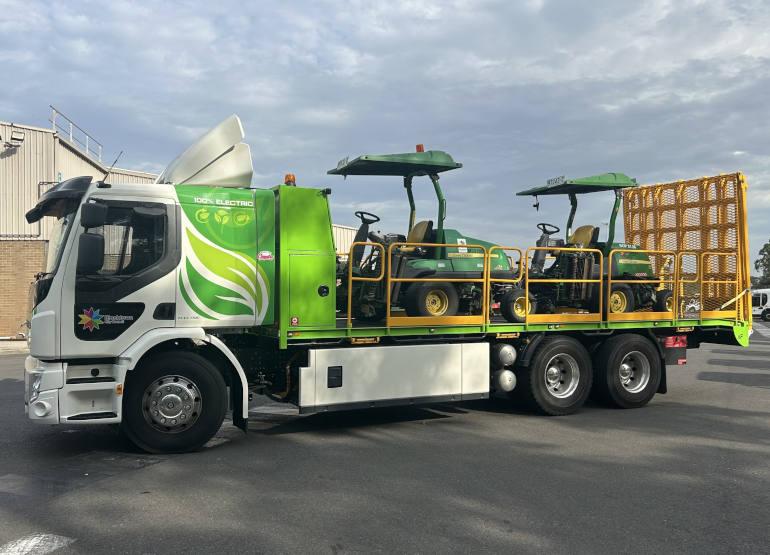
One of the clearest examples of Blacktown’s approach is an electric truck known internally as Cleopatra.
Council originally had three ageing diesel trucks transporting six mowing machines to different worksites. Once the equipment was unloaded, the trucks could spend much of the remaining day parked and idling.
Rather than replace the three vehicles like-for-like, the fleet team redesigned the operation.
A single electric truck fitted with a custom beavertail body can carry two machines at a time. The team leader begins approximately 15 minutes earlier, delivers the equipment to three sites and returns to collect it at the end of the day.
The new model completes six equipment movements while replacing three diesel trucks with one highly utilised electric vehicle.
It has reduced fuel use, idling, maintenance, registration and the number of vehicles and drivers required. Removing trailers has also improved safety.
Electrifying plant and equipment
Blacktown City Council is applying the same principles to parks and gardens equipment.
When petrol-powered equipment is due for replacement, the fleet team assesses whether a battery-electric alternative can perform the task.
During the previous financial year, Council purchased approximately 500 pieces of equipment. Around 400 were zero-emission alternatives.
These included blowers, line trimmers, hedge trimmers and other handheld tools.
Some work vehicles have been fitted with solar panels and trickle-charging systems. While one battery is being used, another can charge on the vehicle, reducing the need to return to a depot or carry additional fuel.
Electric equipment also delivers benefits beyond emissions. Operators experience less noise and vibration, while teams no longer need to transport and handle petrol for many everyday tasks.
Council acknowledges that battery equipment is not yet suitable for every application. High-powered chainsaws, large chippers and other demanding assets may still require conventional power until the technology improves.
Tackling the hardest vehicles
Waste collection vehicles are among the largest sources of fleet emissions, but suitable zero-emission replacements remain limited.
Blacktown City Council is working with an original equipment manufacturer and engineering partners on an electric side-loading waste truck designed for Australian conditions.
The development process has included extensive data collection, route analysis and measurement of road gradients. Council expects two vehicles to enter testing, followed by a 12-month trial involving industry partners and different operating environments.
If successful, the project could provide a pathway for other Australian waste fleets.
An electric side loader would reduce tailpipe emissions and operating noise. Its electric power take-off and compaction equipment could also allow some services to operate with less disruption to residents.
Bringing operators into the process
Council employees are involved from the beginning of the procurement process.
Drivers and operators trial vehicles and equipment, provide feedback and help determine whether an option is fit for purpose. This makes the arrival of new technology less of a surprise and gives employees confidence that operational requirements have been considered.
The benefits are often explained in terms that matter directly to operators, including comfort, reduced noise, easier driving and less vibration.
One driver moving from a conventional prime mover to an electric truck commented on how much more he could hear around the vehicle. Other operators reported improved comfort and reduced back pain.
As Kris Nair, Manager City Fleet at Blacktown City Council, explained during the interview: “It’s sustainability of people as well, not just the environment.”
Results at a glance
- Approximately 2,000 fleet and plant assets
- A roadmap targeting zero tailpipe emissions by 2034
- Council reports 51 per cent of vehicles are EV or plug-in hybrid
- An annual target of 20 per cent emissions reduction
- Three diesel trucks replaced by one electric truck
- Measured idling in one group reduced from approximately three hours to 1.5 hours
- Around 400 of 500 recently purchased plant items were zero-emission alternatives
- Electric side-loading waste trucks progressing towards real-world trials
Sharing the lessons
Blacktown’s work is attracting attention from other local governments.
Council has received enquiries from organisations across regional and metropolitan New South Wales seeking advice on electrification, telematics and asset selection.
Its advice is based on application rather than ideology. Some electric solutions will work in dense urban operations but may not suit a council covering long regional distances.
Blacktown’s team is willing to share both the successes and the limitations, helping other fleets understand their data before committing to a particular technology.
Vote for Blacktown City Council in the Fleet Sustainability Award and recognise a program that combines ambition with practical, measurable action.