
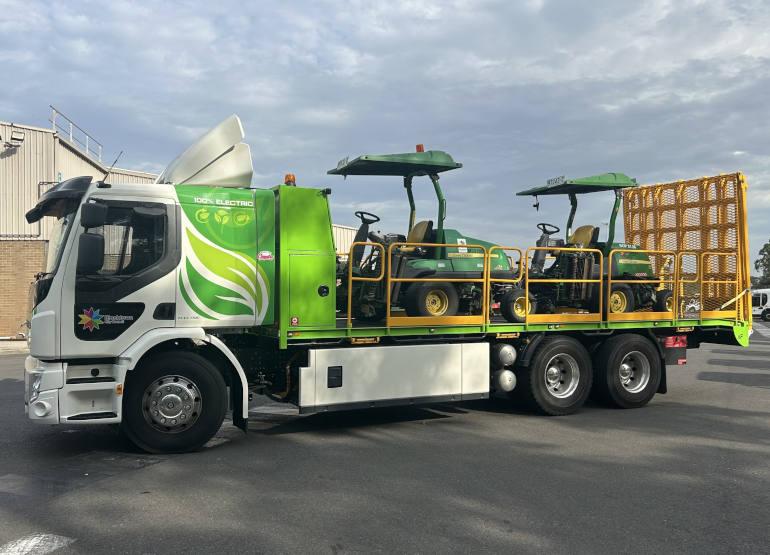
How Blacktown City Council replaced three underused trucks with one electric workhorse
Blacktown City Council has combined telematics, electrification, engineering design and operational change to solve a problem that conventional fleet replacement would not have addressed.
Fleet data showed that three ageing diesel trucks assigned to mowing crews were travelling relatively short distances before spending much of the day parked at worksites. The machinery carried by the trucks was doing the work, while the vehicles remained underutilised and often idling.
Instead of replacing all three trucks, Council redesigned the operation around one highly utilised electric vehicle. The result is a practical technology solution that reduces fleet size, eliminates unnecessary idling and delivers wider cost, safety and environmental benefits.
Why vote for Blacktown City Council?
Blacktown City Council has used multiple forms of technology to deliver one integrated result.
Telematics exposed the problem. Operational analysis identified a new way of working. Electrification removed fuel use and engine idling. Engineering software supported a safe custom body, while solar power and portable charging improved the truck’s practicality.
The challenge
The three trucks were used to transport fairway mowers and other equipment to different locations across Blacktown.
Once the equipment had been unloaded, the trucks could remain at the site for the rest of the working day. Telematics showed that the vehicles were perceived as highly utilised because they were allocated to busy operational teams, but their actual movements told a different story.
The trucks were travelling no more than approximately 150 kilometres per day. Their engines could also remain running while employees used the vehicles for air conditioning during breaks.
This pushed fuel consumption and idling higher without increasing productive output.
All three trucks were also reaching replacement age. Council did not have sufficient funding to replace them like-for-like, creating a strong incentive to reconsider the operating model rather than simply purchase new versions of the same assets.
Turning fleet data into a new operating model
The project began in early 2025 with a detailed review of telematics information collected over periods ranging from six months to two years.
Council used the data to understand:
- how far each truck travelled
- how long it remained stationary
- when and where the equipment was required
- how many machines needed to be transported
- whether one vehicle could complete the work previously assigned to three.
The analysis showed that the operation could be reorganised around a single vehicle.
Under the new model, the team leader begins approximately 15 minutes earlier and uses the truck to deliver two machines at a time to different sites. The vehicle then returns to collect the next equipment or performs other transport tasks before collecting the machines at the end of the day.
One vehicle now completes the work previously performed by three trucks.
Designing the electric truck in-house
Blacktown City Council did not purchase a standard electric truck and attempt to make it fit the task.
Its engineering team developed the concept for a custom beavertail body capable of carrying two mowers or other pieces of plant. Council worked with the bodybuilder and vehicle manufacturer to turn the concept into a production-ready asset.
Three-dimensional design software and finite element analysis were used to assess the tray, ramps and different loading scenarios.
The team examined whether the ramps could safely tolerate the required loads and whether the vehicle could carry different combinations of mowers, tractors and other plant.
The analysis also included:
- vehicle turning radius
- steering effort
- driver comfort
- ergonomics
- ease of operation
- load positioning
- compliance with relevant design and safety standards.
This ensured the final vehicle was not only technically capable but suitable for daily use by operational employees.
Solar-supported hydraulic ramps
The hydraulic ramps are powered by a separate auxiliary battery rather than drawing energy from the truck’s traction battery.
Solar panels mounted on the toolbox support the auxiliary system. This allows the ramps to operate without reducing the electric truck’s driving range.
It is a relatively small feature, but it demonstrates the detailed thinking behind the project. Council considered how each part of the body would affect range, reliability and the vehicle’s ability to complete its daily work.
The truck returns to base for overnight charging and, based on its current kilometres, can operate for two or three days between charges.
Council has also introduced a portable DC charger that can be moved between operational locations. This provides flexibility if the truck needs to charge at the workshop or another Council site rather than returning to one fixed charging bay.
Eliminating idling and increasing utilisation
The previous vehicles could spend much of the day stationary. The electric truck now remains productive after completing the morning equipment deliveries.
Other departments can use it to move plant, elevated work platforms, compact machinery and other assets.
This has increased utilisation beyond the original mowing operation and encouraged teams to share one capable asset rather than retain several vehicles that spend significant periods parked.
Council says employees are now competing for the opportunity to drive the truck because it is smoother, more powerful and easier to operate than the vehicles it replaced.
The project is therefore changing attitudes towards both electric trucks and shared fleet assets.
Improving safety
Replacing three trucks with one has reduced the number of vehicles and drivers exposed to road risk.
The previous operating model also involved older trucks and trailers. The new beavertail body is permanently attached to the electric truck, removing risks associated with towing, reversing trailers, overhanging loads and trailer instability.
Council also considered:
- the reduced number of vehicle movements
- the safety technology available in a newer truck
- driver visibility
- vehicle manoeuvrability
- loading and unloading risks
- operator fatigue and comfort.
The vehicle manufacturer delivered practical training covering operation, charging and the truck’s safety systems.
This training was supported by repeated employee engagement throughout the design and procurement process. Council identified early involvement as one of the most important lessons from the project.
Results at a glance
- Three diesel trucks replaced by one electric truck
- Unnecessary engine idling effectively eliminated from the operation
- Vehicle utilisation targeted to increase from around 50 per cent to 80–90 per cent
- Reduced fuel, maintenance, registration and whole-of-life costs
- One driver completing work previously involving three vehicles
- Solar-supported auxiliary battery powering the hydraulic ramps
- Portable DC charging introduced for greater operational flexibility
- Trailers removed from the transport task
- Fewer vehicles and drivers exposed to road risk
- Additional departments now using the vehicle for other plant movements
A model that can be repeated
The first vehicle was introduced as a trial in one operational zone, but Council believes the model can be expanded.
Blacktown’s north-west corridor is experiencing significant growth, creating greater demand for parks, maintenance and community services. Council is now considering how the same combination of shared assets, electric vehicles and redesigned work practices could support these areas.
The project also provides a model for other councils. Many local government fleets operate trucks that transport plant to a site and remain parked while the equipment completes the work.
Blacktown’s experience shows that telematics data can challenge assumptions about utilisation and reveal opportunities to consolidate assets.
The most important lesson was not simply to purchase an electric truck. It was to start with the work that needed to be completed and design the fleet around that task.