
How the City of Parramatta turned EV resistance into measurable results
When the City of Parramatta surveyed employees about electric vehicles, approximately 90 per cent of respondents said they were not interested in making the transition.
At the time, Council had only one electric vehicle in a fleet of approximately 350 vehicles.
Rather than allow that resistance to delay its sustainability plans, the City of Parramatta changed its fleet policy, introduced electric vehicle drive days, expanded charging infrastructure and developed a carefully researched vehicle list.
The result was the procurement of 22 electric vehicles, an reduction of CO2 emissions and combined procurement and infrastructure savings of approximately $323,000.
Why vote for the City of Parramatta?
The City of Parramatta has shown how an organisation can move from limited EV experience and strong employee resistance to a coordinated, measurable transition.
Its program combines fleet policy, whole-of-life analysis, bulk procurement, grant funding, charging infrastructure, employee drive days and cross-departmental collaboration.
Starting with policy
The transition began during a fleet policy review in 2024.
The previous policy did not contain clear provisions encouraging employees to select electric vehicles or explaining how charging, leaseback vehicles and pool cars would be managed.
Council used the review to align its fleet rules with its wider net-zero objectives.
The new policy clarified how electric vehicles would operate within the leaseback and pool fleets, how public charging would be managed and what support would be available for employees.
The City of Parramatta does not provide home charging installations, so workplace and public charging needed to be accessible and straightforward.
The policy also established an emissions threshold for leaseback vehicles. Vehicles exceeding approximately 128 grams of CO₂ per kilometre generally cannot be selected unless there is a clear operational requirement and senior approval.
Council no longer procures conventional petrol or diesel passenger vehicles. New passenger vehicles must be hybrid or electric.
Letting employees experience the vehicles
Changing the policy was only the first step.
Council needed to address employee concerns about range, charging, comfort and unfamiliar technology.
It worked with vehicle dealers to organise an EV drive week at the Rydalmere depot. Several electric vehicles were available for employees to inspect and test over an extended period.
Leaseback drivers and regular pool-vehicle users could compare models and experience electric driving without immediately committing to a vehicle.
The event produced positive feedback and helped Council identify three models that offered an appropriate balance of cost, range and size.
The drive week has since become an annual initiative. Council continues to assess new vehicles as they enter the market and uses employee feedback to refine the approved vehicle list.
Early adopters have also become internal champions, sharing their experiences and helping reassure colleagues considering an EV for their next replacement.
Using procurement scale to reduce costs
Once suitable vehicles had been selected, Council issued a bulk invitation to employees and coordinated its purchases.
Ordering 22 vehicles together allowed the fleet team to negotiate discounts that would not have been available through individual purchases.
Council reported discounts of approximately $16,000 per vehicle on one model and between $9,000 and $10,000 on another electric SUV.
The City of Parramatta also applied for available electric vehicle grants.
Together, the negotiated discounts and grant funding contributed to approximately $323,000 in procurement and infrastructure savings.
Deliveries were staged to align with the completion of the charging project and the conditions of the grant, which required the vehicles to be purchased within a defined period.
This coordination between the fleet and sustainability teams was critical. Vehicles were not delivered before the infrastructure was ready, and the infrastructure project remained aligned with the procurement timetable.
Building the charging network
Charging infrastructure was planned as a joint project between fleet and the City’s sustainability team.
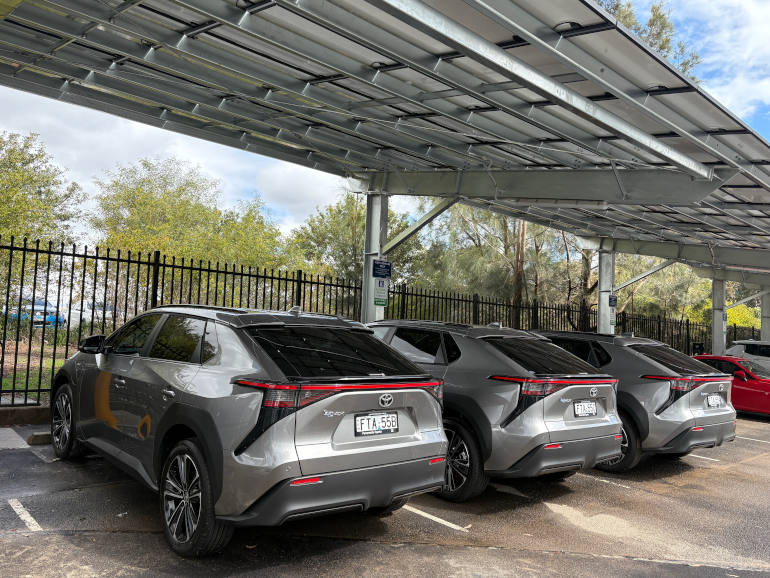
Solar panels and an initial 14 chargers were installed at the Rydalmere depot, with the electrical capacity to support 20 chargers. The remaining units were subsequently added, creating a row of 20 charging points.
The installation includes a combination of seven-kilowatt and 22-kilowatt chargers.
Approximately 90 per cent of Council’s passenger fleet leaseback drivers are based at the depot, allowing vehicles to charge while employees are at work.
Drivers also receive cards for access to a public charging network when they are away from the depot.
By installing charging before accelerating vehicle deliveries, Council removed one of the strongest practical objections raised by employees.
From one EV to 22
Before the program, the City of Parramatta had one electric Hyundai Kona.
The bulk procurement introduced 22 additional electric vehicles across the leaseback and pool fleets. Approximately half were allocated as leaseback vehicles and half as pool cars.
Council has also established that pool cars will be replaced with electric vehicles when they reach the end of their service life.
Although only a proportion of the 170 leaseback vehicles have so far transitioned to fully electric models, Council says it has already achieved its internal 2030 objective for the leaseback fleet to consist of electric or hybrid vehicles.
The longer-term target is a fully electric passenger fleet as the organisation progresses towards net zero by 2050.
Looking beyond passenger vehicles
The passenger fleet is the most advanced part of Parramatta’s transition, but the program is expanding.
Council conducts an annual audit of its entire fleet, collecting odometer readings and reviewing utilisation. Although telematics has not yet been installed, the audit has allowed the fleet team to identify underused assets.
Recent reviews resulted in the removal of two heavy trucks, several trailers and tractor attachments.
Council is now assessing electric light commercial vehicles, beginning with petrol-powered amenity vans used by the cleansing team.
Heavy electric trucks remain difficult to justify because of their purchase price, even when grants are available. Council is therefore beginning with applications where the technology and financial case are more mature.
Small plant is also reviewed during replacement. Petrol-powered equipment will be replaced with battery alternatives where they can perform the required task.
Reducing costs during the transition
Not every sustainability improvement requires a new vehicle.
Council also reviewed the fuel grades being purchased for its remaining combustion and hybrid vehicles. The general provision was reduced from premium 98-octane fuel to 95 and then to 91-octane or E10 where approved by the manufacturer.
Higher-octane fuel is now reserved for the small number of vehicles that require it.
This change has reduced fuel costs while Council continues replacing the remaining vehicles.
Results at a glance
- Approximately 350 vehicles
- An additional 400 to 450 items of small plant
- 22 electric vehicles procured
- Approximately $323,000 in procurement and infrastructure savings
- 20 workplace charging points installed
- Solar generation incorporated into the charging project
- Around $16,000 saved per vehicle on one bulk-purchased model
- Conventional petrol and diesel passenger vehicles removed from the approved procurement list
- Two underutilised heavy trucks and several other assets removed
A structured transition
The City of Parramatta’s progress did not come from assuming employees would automatically support electric vehicles.
It began with strong resistance and addressed it through policy, education, practical experience and infrastructure.
The program also demonstrated the value of collaboration. Fleet managed vehicle policy, selection and procurement, while the sustainability team delivered the charging and solar infrastructure.
“We’ve delivered a really structured, data-driven fleet emission reduction program,” Reweena Kaur, Coordinator Fleet and Trade Services at City of Parramatta, said during the finalist interview.
The combination of measurable environmental, operational and financial outcomes has given Council a foundation for the next stage of its transition.
Vote for the City of Parramatta in the Fleet Sustainability Award and recognise a practical program that has reduced emissions, achieved significant savings and changed attitudes towards electric vehicles.